Commend IP Amplifiers
Version: 1.0.4 ENG
Date: November 7, 2024
Product: CyberTwice CyberGate with Commend IP Amplifiers
Supported Commend IP Amplifiers
Section titled “Supported Commend IP Amplifiers”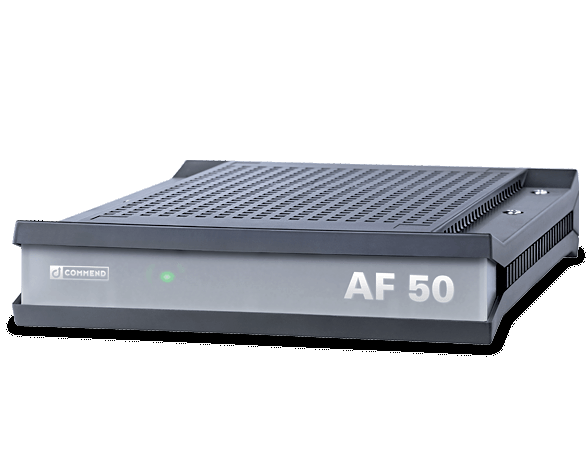
This document uses the Commend AF 50 IP Amplifier as the reference device. The following Commend IP Amplifiers are also supported:
| Model | Description |
|---|---|
| AF 20 | IP Amplifier |
| AF 50 | IP Amplifier |
| AF 125 | IP Amplifier |
| AF 250 | IP Amplifier |
| AF 500 | IP Amplifier |
All listed Commend IP Amplifiers are certified for secure communication with CyberGate.
Document Contents
Section titled “Document Contents”| Section | Description |
|---|---|
| Basic Configuration | Steps to configure the Commend for CyberGate |
| Secure Communication | Enable encrypted SIP-TLS connection |
| Calling from Teams | How to initiate calls from Teams to the device |
| Appendix: CyberGate App | Installation and usage of the CyberGate Teams app |
Note: This manual describes the most basic configuration of the Commend IP Amplifier for use with CyberGate. Advanced Commend features work with CyberGate but are not described here. Refer to Commend documentation for additional configuration options.
CyberGate Teams App Features
Section titled “CyberGate Teams App Features”The CyberGate app for Microsoft Teams provides:
- 📊 Device status — View device online/offline status and initiate calls with one click
- 👥 Availability — Set your status in CyberGate Multi-ring groups
Recommendation: Installation of the CyberGate app for Microsoft Teams is highly recommended.
Configuration Steps
Section titled “Configuration Steps”Step 1: Connect to the Commend
Section titled “Step 1: Connect to the Commend”- Connect the Commend to the network
- Power it on
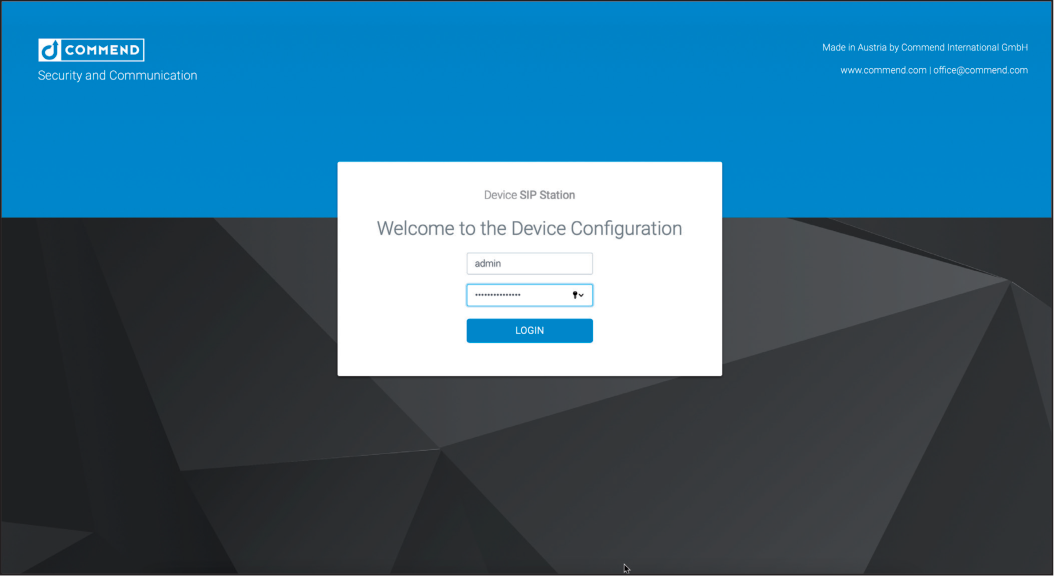
- Open a web browser and navigate to the device’s IP address
- Sign in with the configured or supplied password
Step 2: Access the Home Menu
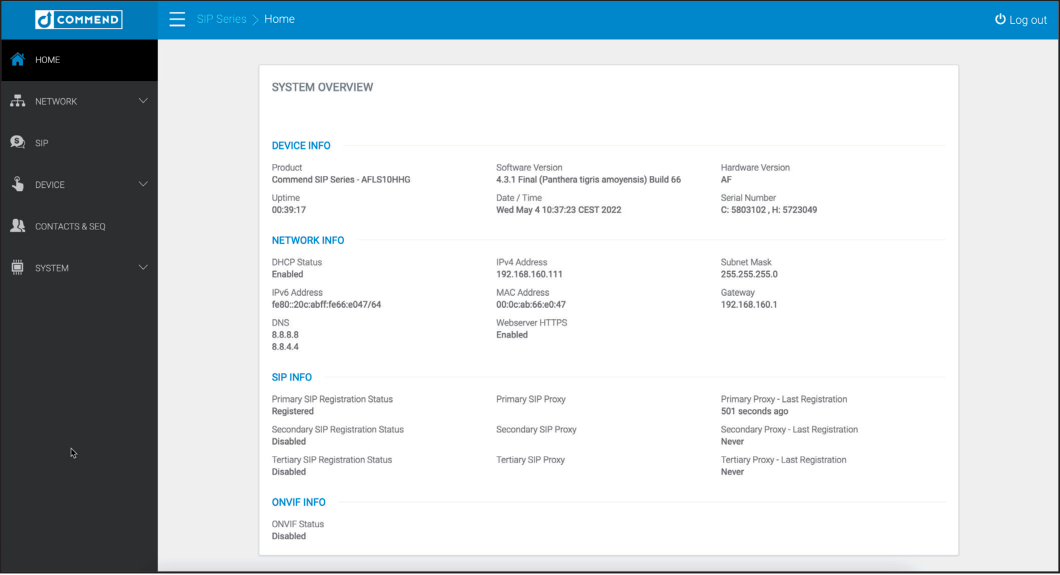
Section titled “Step 2: Access the Home Menu”After signing in successfully, the Home menu is displayed.
Step 3: Configure SIP Settings
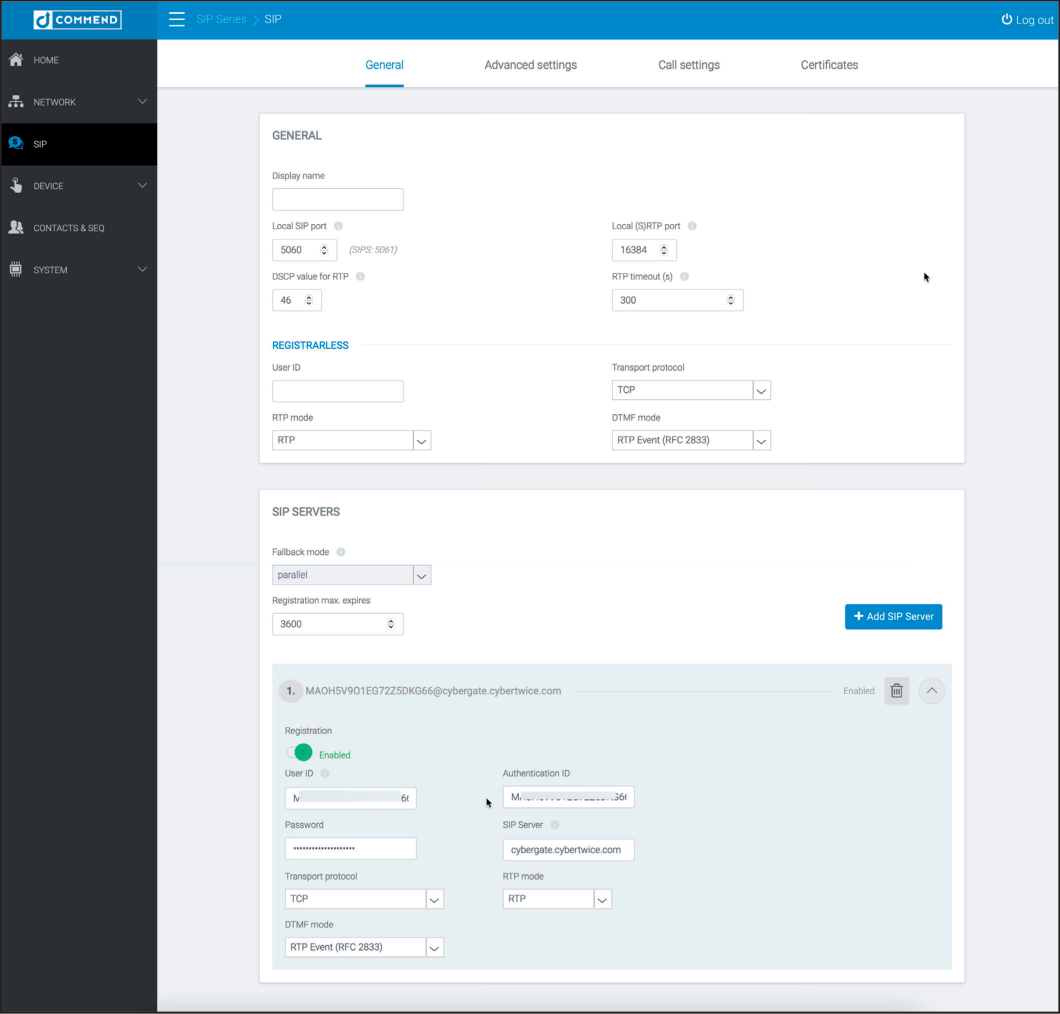
Section titled “Step 3: Configure SIP Settings”- Navigate to the SIP menu
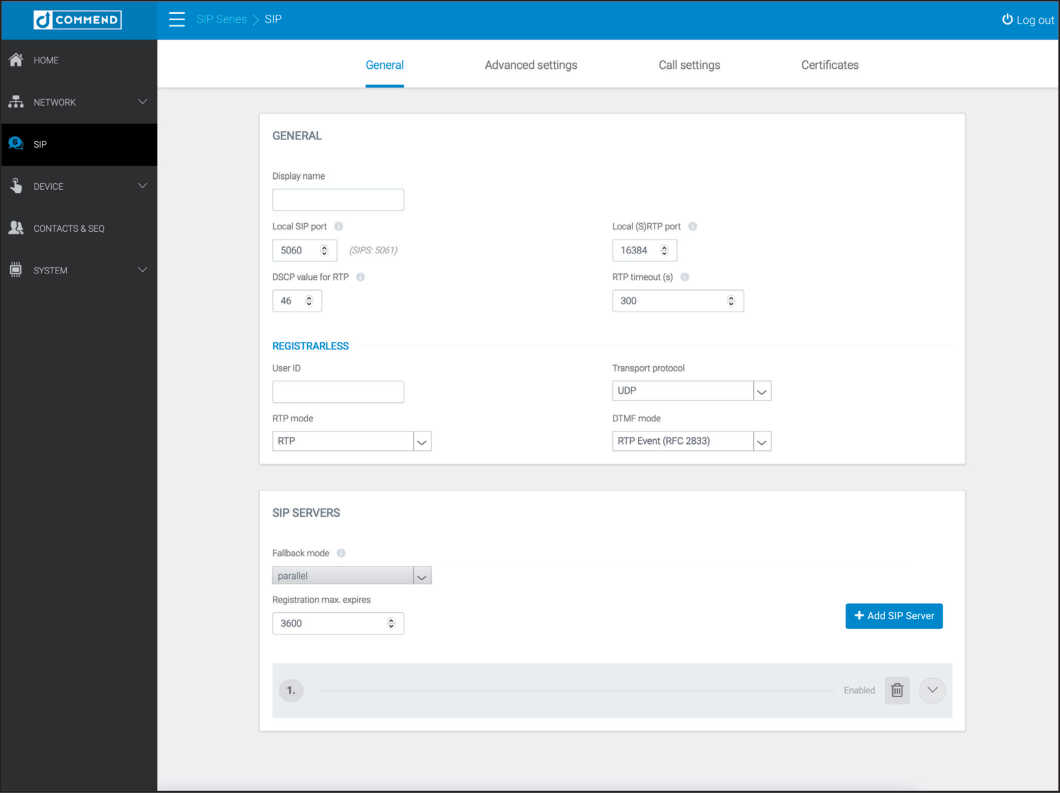
- Open SIP server 1 and configure the following settings:
| Field | Value |
|---|---|
| Registration | Enable registration |
| User ID | Define a name (one word) for the amplifier (e.g., Production) |
| Authentication ID | Use the Username from CyberGate Management Portal |
| Authentication Password | Use the Password from CyberGate Management Portal |
| SIP Server | cybergate.cybertwice.com |
| Transport Protocol | TCP |
- Click ‘Save’ when done
Step 4: Configure DTMF Relay (Optional)
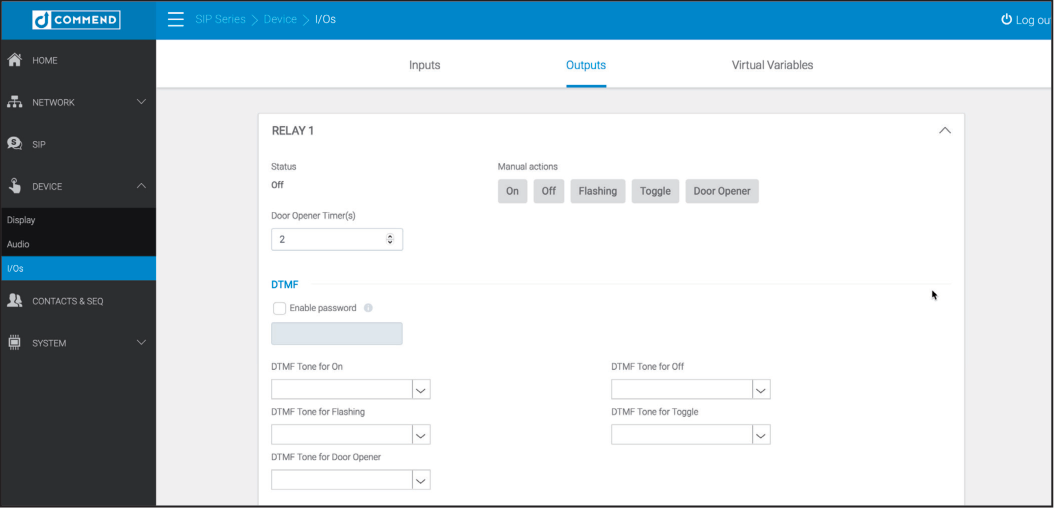
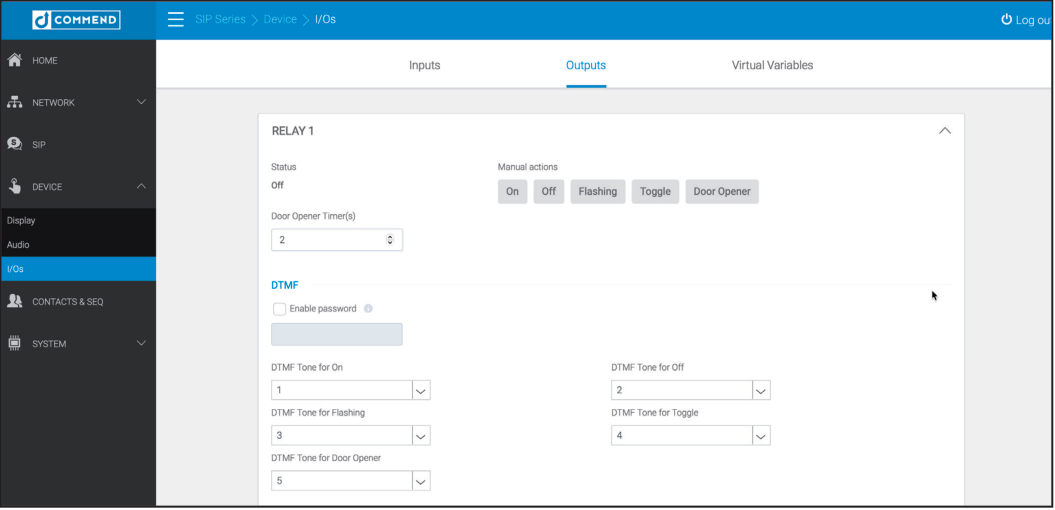
Section titled “Step 4: Configure DTMF Relay (Optional)”- Navigate to the Device-I/Os menu
- Define the DTMF tones for the internal relay in the Commend
In this example, DTMF tones 1-5 are used.
Step 5: Test the Configuration
Section titled “Step 5: Test the Configuration”The basic configuration of the Commend for use with CyberGate is now complete. Test the functionality by initiating a test call to a Teams user.
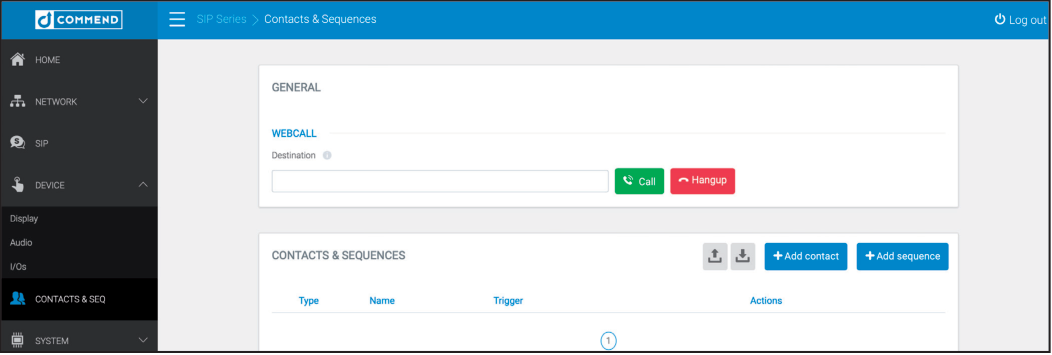
- Navigate to the Contacts & Seq menu
- At WEBCALL, add a Destination
Destination Address Format
Section titled “Destination Address Format”Use the format: username@cybergate.cybertwice.com
Example:
For Teams user Koos Ridder with emailkoos.ridder@mycompany.com
Enter:koos.ridder@cybergate.cybertwice.com
- Click ‘Call’ to initiate a test call to the Teams user
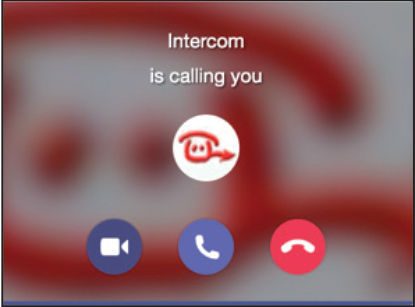
- Answer the call and verify that audio from Teams sounds through the speaker(s) connected to the Commend
Step 6: Configure CyberGate Admin Portal
Section titled “Step 6: Configure CyberGate Admin Portal”Before calls can be initiated from Microsoft Teams to the Commend, additional configuration in the CyberGate Admin portal is necessary.
- Navigate to: https://admin.cybergate.cybertwice.com
- Log in using a Microsoft account with admin privileges
- Navigate to Device Settings menu
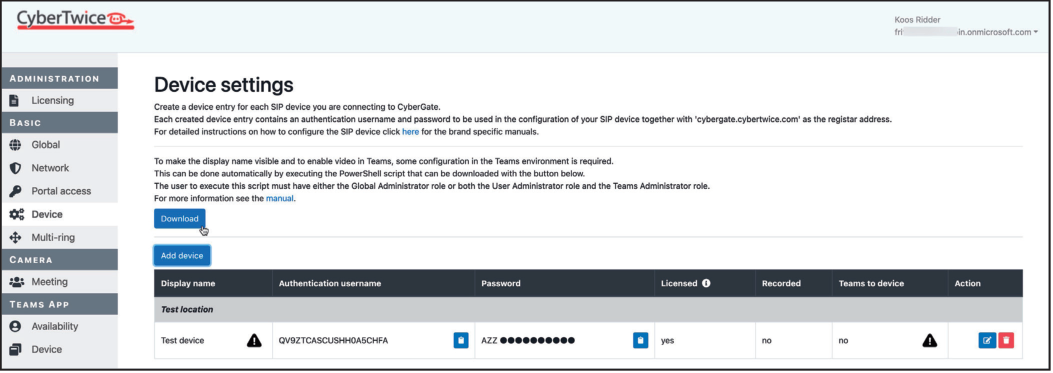
- If the display name shows a warning symbol ⚠️, download and run the Feature configuration PowerShell script:
- Click the blue ‘Download’ button
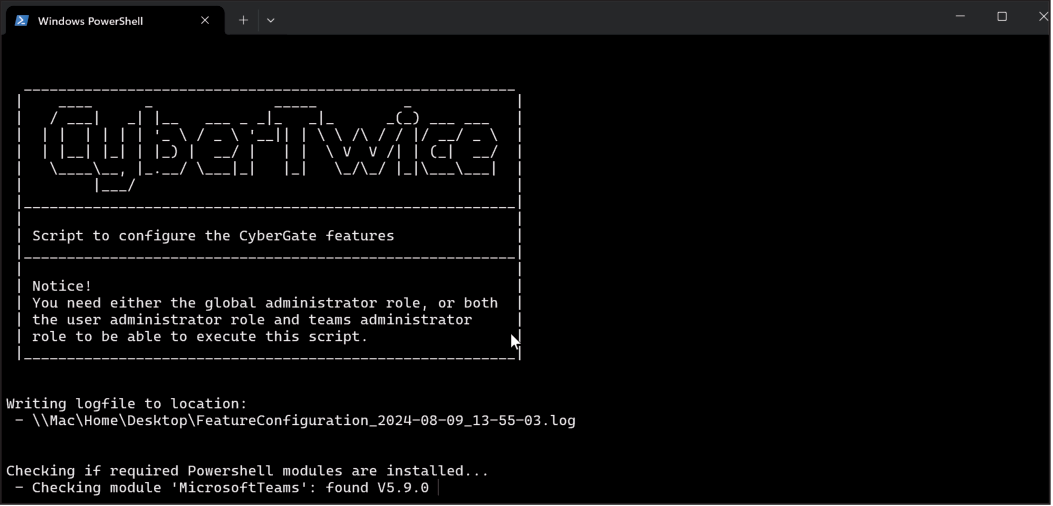
- Open PowerShell on your PC with administrator privileges
- Run:
./FeatureConfiguration.ps1 - When prompted, authenticate with the same Microsoft account used for the CyberGate Admin portal
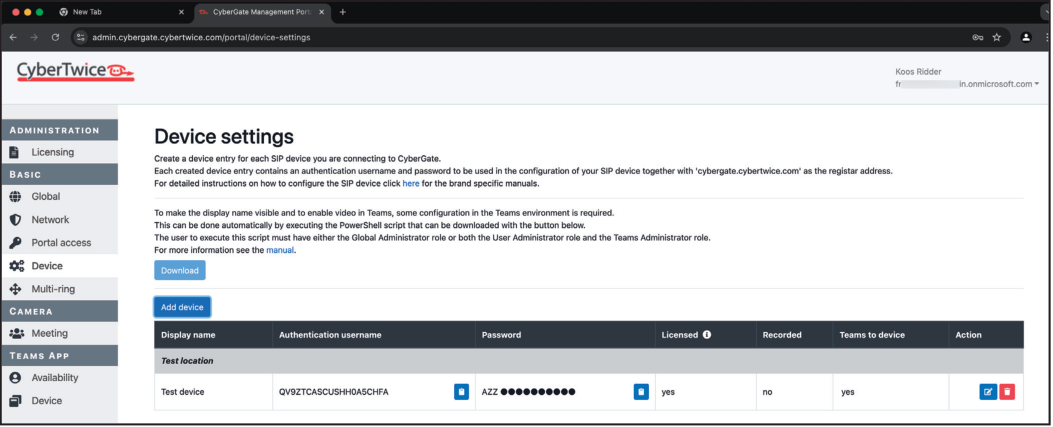
After successful execution, the warning symbol will disappear and the ‘Teams to device’ column will change from ‘no’ to ‘yes’.
Calling from Microsoft Teams
Section titled “Calling from Microsoft Teams”To initiate a call from Microsoft Teams to the Commend, you have two options:
Option 1: Using the Teams Calls Menu
Section titled “Option 1: Using the Teams Calls Menu”- Login to Microsoft Teams
- Navigate to the ‘Calls’ menu
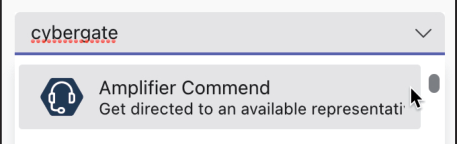
- Either:
- Type the display name of the Commend in the call field, or
- Search for ‘cybergate’ to see all your CyberGate devices
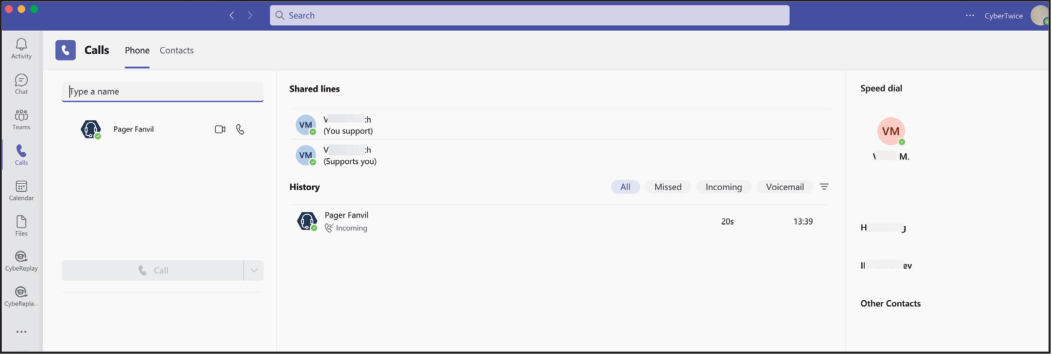
- Select the device to call and click the blue ‘Call’ button
- The Commend will answer automatically
Tip for Relay Control: When the internal relay is configured, click the three dots (…) in the call screen and select ‘Keypad’. Use the keypad to operate the relay with DTMF tones.
Option 2: Using the CyberGate Teams App
Section titled “Option 2: Using the CyberGate Teams App”A more convenient method is using the CyberGate for Microsoft Teams app. See the Appendix for installation and operating instructions.
Secure Communication over SIP-TLS
Section titled “Secure Communication over SIP-TLS”For encrypted communication with CyberGate, modify the configuration as follows:
Step 1: Download CA Root Certificate
Section titled “Step 1: Download CA Root Certificate”Download the CA Root Certificate from the CyberTwice support site:
https://support.cybertwice.com/knowledgebase.php?article=36
Step 2: Configure TLS and SRTP
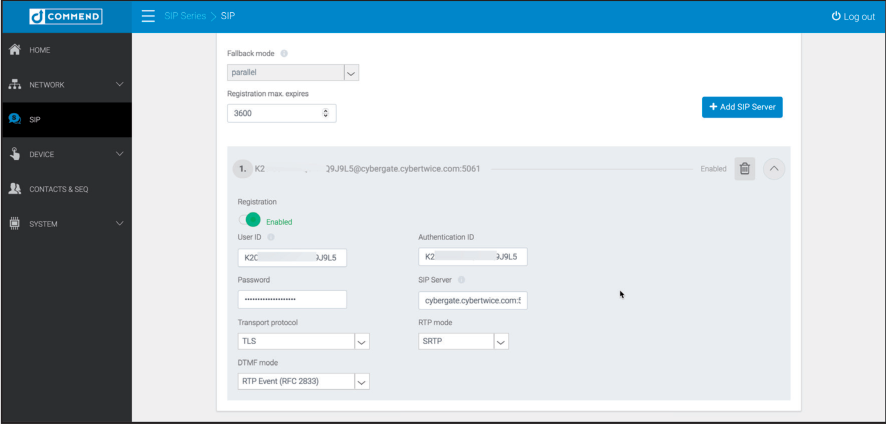
Section titled “Step 2: Configure TLS and SRTP”- Navigate to the SIP-General menu
- Modify the following settings:
| Field | Value |
|---|---|
| SIP Server | cybergate.cybertwice.com:5061 |
| Transport Protocol | TLS |
| RTP Mode | SRTP |
- Click ‘Save’ when done
Step 3: Upload CA Certificate
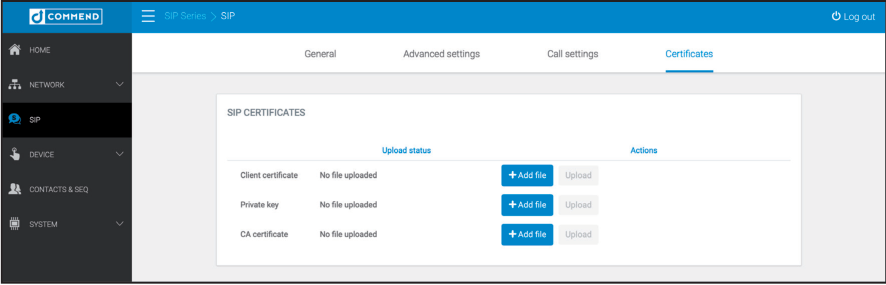
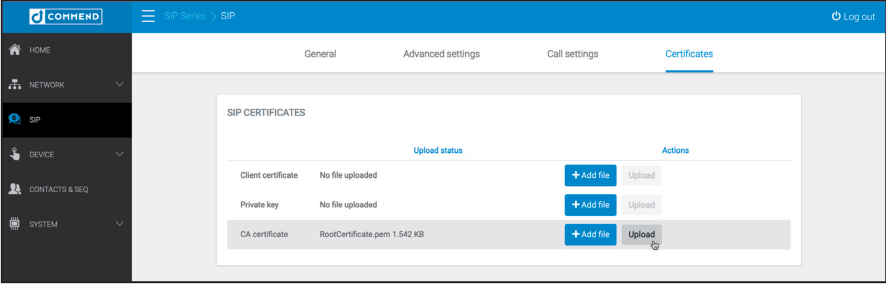
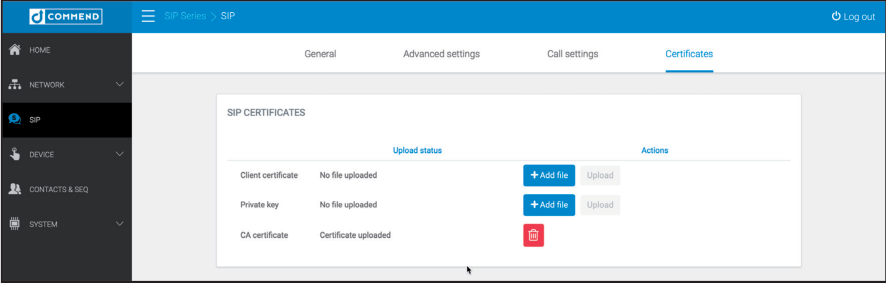
Section titled “Step 3: Upload CA Certificate”- Navigate to the SIP-Certificates menu
- At ‘CA Certificates’, click ‘Add file’
- Select and upload the downloaded CA Root Certificate
- Click ‘Upload’ to store the certificate in the Commend
Verify Secure Connection
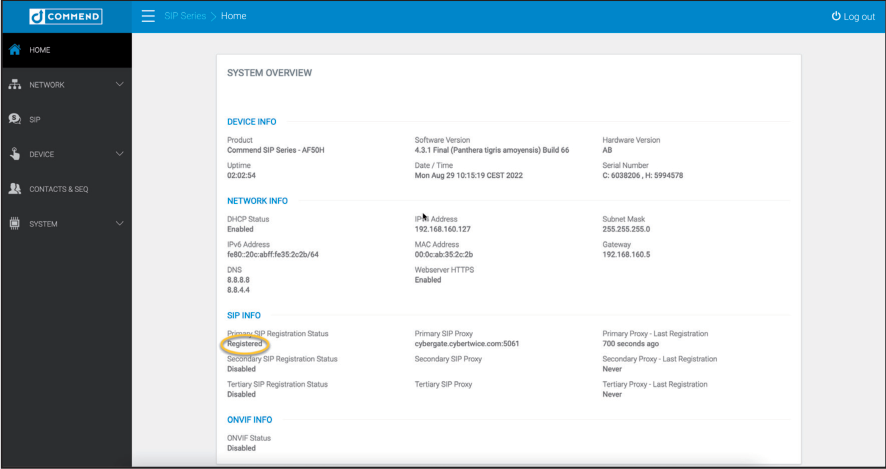
Section titled “Verify Secure Connection”Check the registration status in the ‘Home’ menu to confirm the secure connection.
All SIP and audio traffic to/from CyberGate will now be encrypted.
Quick Reference
Section titled “Quick Reference”CyberGate Connection Details
Section titled “CyberGate Connection Details”| Setting | Value |
|---|---|
| SIP Server | cybergate.cybertwice.com |
| SIP Server (Secure) | cybergate.cybertwice.com:5061 |
| Transport (Standard) | TCP |
| Transport (Secure) | TLS |
| RTP Mode (Secure) | SRTP |
Teams User Address Format
Section titled “Teams User Address Format”username@cybergate.cybertwice.comReplace username with the Teams user’s email prefix (the part before @).
Appendix - CyberGate Teams App
Section titled “Appendix - CyberGate Teams App”Requirements
Section titled “Requirements”To use the CyberGate App, you need a subscription to one of the following CyberGate SaaS solutions:
- ✅ CyberGate for IP Cameras with Teams
- ✅ CyberGate for IP Paging with Teams
- ✅ CyberGate for IP Intercoms with Teams
App Features Overview
Section titled “App Features Overview”The CyberGate Teams app provides two main features:
| Feature | Description |
|---|---|
| Availability | Set your availability status in Multi-ring groups |
| Devices | View device status and initiate calls with one click |
Installation
Section titled “Installation”How to Install
Section titled “How to Install”- Open Microsoft Teams and click on the ‘Apps’ button in the sidebar
- Search for ‘cybergate’
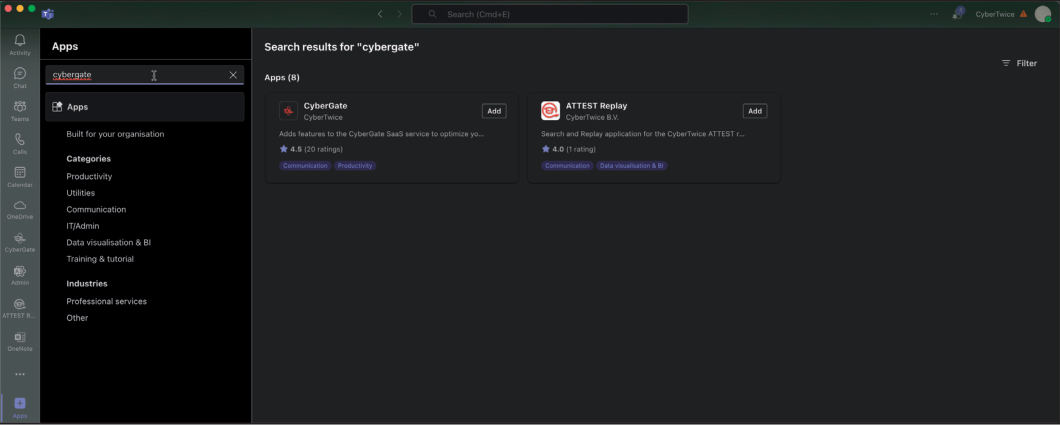
- Click ‘Add’ to add CyberGate to Microsoft Teams
Note: You may be asked to provide consent for basic permissions (View your basic profile, Maintain access to data you have given it access to). Accept these permissions to use the app.
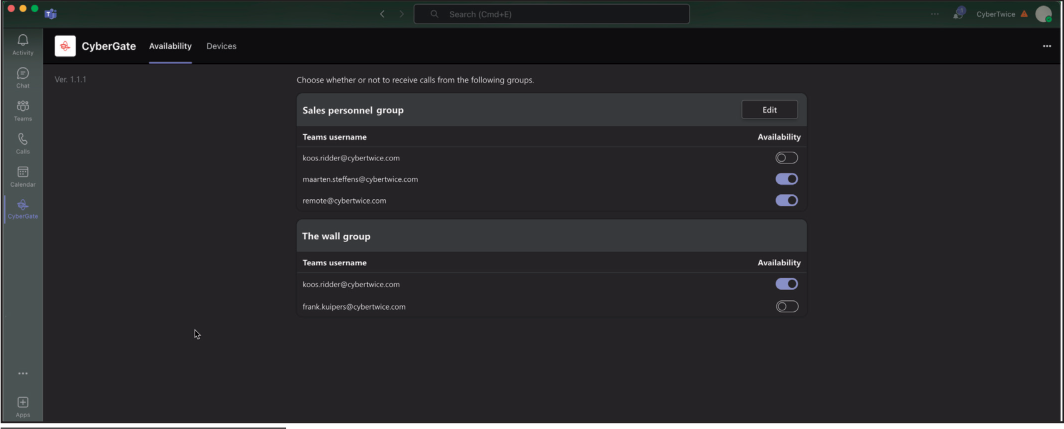
- After installation, the CyberGate app will open and show the availability menu
- Pin the app (recommended): Right-click on the CyberGate icon and select ‘Pin’
Feature 1: Availability
Section titled “Feature 1: Availability”How It Works
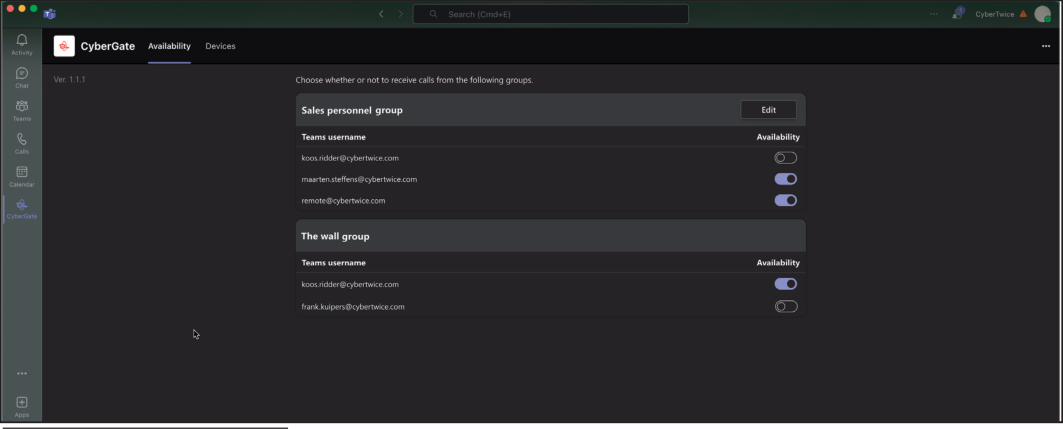
Section titled “How It Works”The CyberGate app uses the same credentials as Microsoft Teams and automatically retrieves information about Multi-ring groups you belong to.
Example Scenario
Section titled “Example Scenario”In this example, the user koos.ridder@cybertwice.com is part of two Multi-ring groups:
| Group | Members | User Role |
|---|---|---|
| Sales personnel group | 3 users | Supervisor (*) |
| The wall group | 2 users | Normal user |
User Roles
Section titled “User Roles”| Role | Permissions |
|---|---|
| Supervisor | Can set availability for ALL users in the group, can add/remove users |
| Normal User | Can only set their OWN availability status |
Availability Status
Section titled “Availability Status”| Status | Effect |
|---|---|
| Available | You can be called by CyberGate |
| Unavailable | You won’t be called by CyberGate |
Note: Availability status changes take effect immediately.
Tip: To configure the supervisor role for a Multi-ring group, use the CyberGate Management Portal.
Feature 2: Devices
Section titled “Feature 2: Devices”How It Works
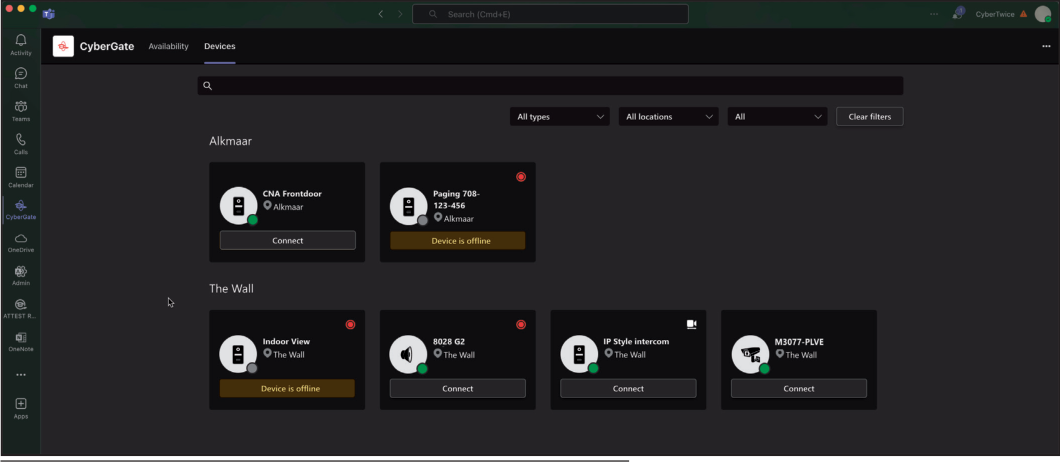
Section titled “How It Works”The Devices menu shows an overview of all configured devices in your Tenant, sorted by location. You can filter results to find specific devices.
Device Tile Information
Section titled “Device Tile Information”Each device tile displays:
| Information | Description |
|---|---|
| Device Type | Intercom, camera, or audio/paging |
| Device Name | Configured name of the device |
| Online Status | Whether the device is online or offline |
| Recording Status | Whether recording is enabled |
| Two-Way Video | Whether two-way video is configured |
Connect Button
Section titled “Connect Button”If a device is configured to receive calls from Microsoft Teams, a Connect button will appear. Clicking this button initiates a call to the device.
Note: The devices shown to a user can be limited using the Device access settings in the CyberGate Management Portal.
Document History
Section titled “Document History”| Version | Date | Author | Change |
|---|---|---|---|
| 1.0.0 | 2022-05-03 | KR | Initial version |
| 1.0.1 | 2022-05-16 | KR | Fixed typos |
| 1.0.2 | 2022-08-29 | KR | Added Security (SIP TLS and SRTP) |
| 1.0.3 | 2024-11-01 | KR | Updated layout |
| 1.0.4 | 2024-11-07 | KR | Fixed text and added CyberGate app appendix |